Review: Copper & Cask “Wave That Flag” Bourbon and “Boston Rum Party” Rye
In 2026, consumers have been inundated with American whiskey releases bearing America 250 branding in celebration of the 250th anniversary of the founding of the United States. For many producers, the formula has been fairly predictable: add an America 250 logo to the label, reference “1776-2026,” and attach a patriotic name. Numerous releases also direct a small portion of bottle sales to nonprofit organizations, often those supporting military veterans, adding a more personal dimension to the anniversary.
What has been far less common, at least through July 2026, are releases that connect the America 250 story to the whiskey itself. In many instances, the patriotic branding begins and ends with the packaging.
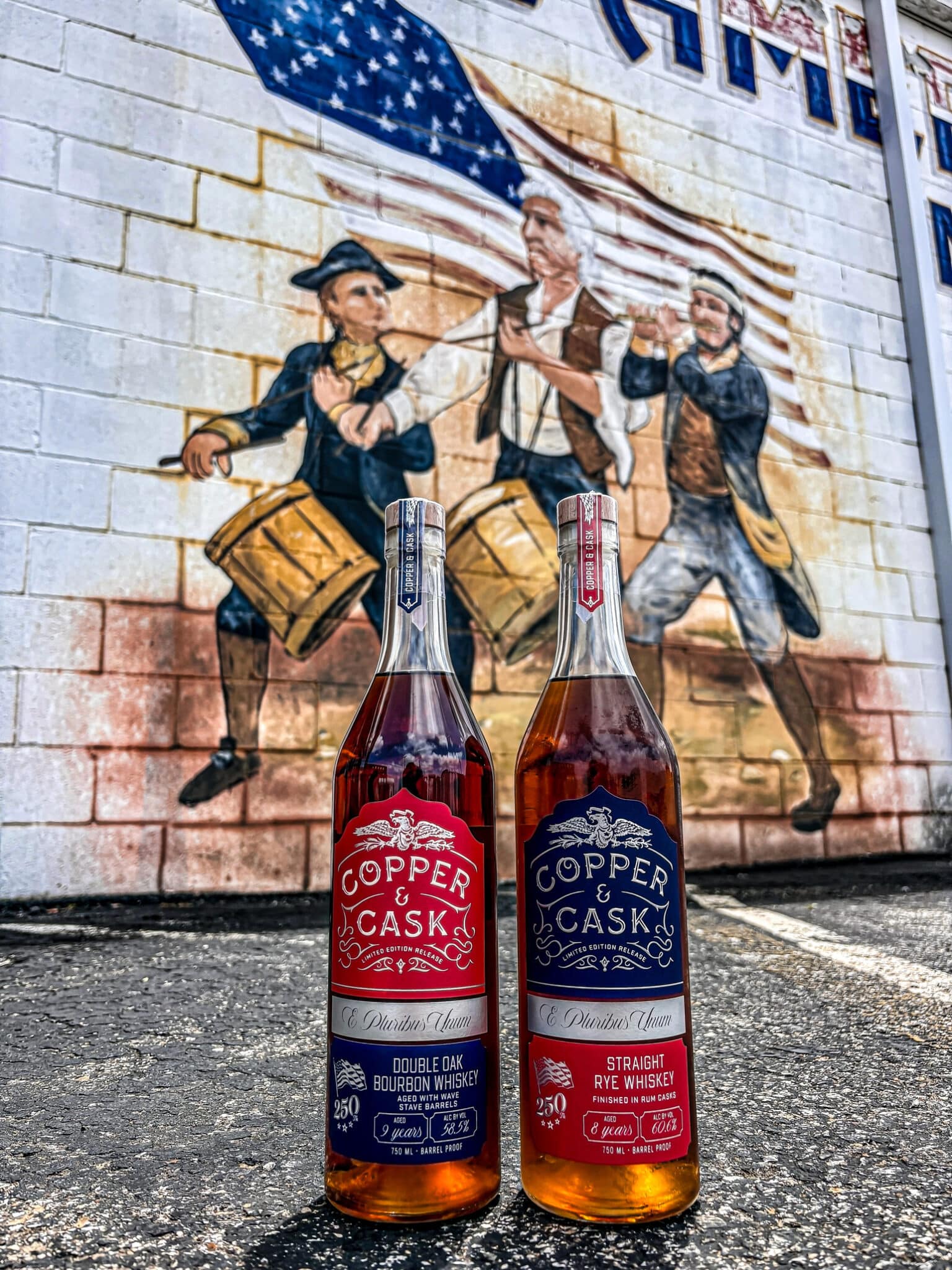
Latitude Beverage Co.’s Copper & Cask Spirits takes a different approach. Distilled by MGP in Indiana, Copper & Cask’s E Pluribus Unum releases, “Wave That Flag” Double Oak Bourbon and “Boston Rum Party” Rye Whiskey, certainly check the expected America 250 boxes. Both feature patriotic names, custom commemorative artwork, and a $1 donation from every bottle sold to the Arcadia Center, a Veteran Farmer Training Program that helps veterans transition into careers in sustainable agriculture.
Those elements alone would place them alongside many other anniversary releases. What separates these bottles is that the production methods also support the America 250 story in a way that comes across as credible rather than manufactured. The connection between the whiskey and the marketing extends beyond the label, giving the entire concept a stronger foundation.
Outside of Whiskey Jypsi Legacy Volume 003: “The Declaration,” few America 250 releases released through July 2026 have tied production decisions and patriotic storytelling together as successfully as Copper & Cask’s E Pluribus Unum series.
With so much effort clearly invested in aligning the production with the anniversary theme, one question remains. Does the whiskey live up to that same level of care? Let’s find out.
Copper & Cask “Wave That Flag” Double Oak Bourbon Review
“Wave That Flag” is a 17-barrel blend of bourbon distilled from a mashbill of 75% corn, 21% rye, and 4% malted barley. The barrels spent at least nine years maturing, with the oldest reaching nine years and two months before being dumped in January 2026 and transferred into Wave Stave barrels produced by ZAK Cooperage. Those barrels featured a #1 char paired with four toast levels, while the bourbon entered at proofs ranging from 114 to 121.
Although Wave Stave barrels have been around for several years, Copper & Cask found an ideal opportunity to tie the technology to its America 250 series through “Wave That Flag.” Rather than a traditional interior, the staves are milled with a wave-shaped contour running their full length, creating alternating peaks and valleys before toasting and charring. The design increases the interior surface area by roughly 20 to 22 percent compared with a standard 53-gallon barrel. Those contours also react differently during the toasting and charring process, producing varying levels of oak influence across the barrel’s interior. The bourbon entered the Wave Stave barrels on January 21, 2026, and was dumped for blending on May 12, 2026, for a secondary maturation lasting three months and 21 days.
The aroma opens with the sensation of standing inside a tobacco barn, where dried tobacco and airborne dust immediately enter the nostrils. That opening quickly suggests a dry palate before the whiskey is even tasted. After a few moments, cherry pie with a scorched crust moves forward, followed by orange gum drops that become the dominant note. While I enjoyed the nose, it never quite found the same level of harmony as the whiskey that followed.
The first sip immediately changes the conversation. Root beer foam and Boston cream filling arrive first, followed by Hi-C Orange drink and ginger snap cookies across the mid-palate. Given what the aroma suggested, the quality of the palate caught me by surprise. It delivers excellent flavor definition from start to finish, with rye spice remaining in check rather than pulling the whiskey in competing directions. A medium-thick mouthfeel makes it all stick without feeling syrupy.
The finish shifts toward burnt orange peel and soft leather before German-roasted pecans take over. A faint note of wintergreen appears at the very end, providing one last cooling accent before the flavors fade.
I enjoy whiskey finished in secondary casks, yet when I’m choosing from the hundreds of bottles in my own collection, I almost always reach for a straight bourbon or rye instead. I’ve tasted plenty of toasted bourbons that I genuinely like, but very few leave me wanting another pour after the review is finished. Alongside the 2026 release of Green River Toasted Double Oak Bourbon, Copper & Cask’s “Wave That Flag” joins a very short list of toasted bourbons that I expect to revisit on purpose. There are more than a few toasted bottles at home that have spent far too much time untouched. This won’t be one of them. 117 proof. A- / $75
Copper & Cask “Boston Rum Party Straight Rye Whiskey Review
“Boston Rum Party” is a 10-barrel blend of rye whiskey distilled from a mashbill of 95% rye and 5% malted barley. Before finishing, the barrels ranged from six years old to ten years and four months before being transferred into rum casks sourced from Appleton Estate in Jamaica’s Nassau Valley. Jamaican rum is frequently associated with the intensely funky profile known as hogo, though Appleton’s style remains considerably more reserved than producers such as Hampden Estate. The rye entered the rum casks at roughly 115 to 116 proof across several filling dates, primarily during February 2024 and November 2025. Secondary maturation ranged from six months to 26 months before the rum barrels were dumped on April 23, 2026.
While the American Revolution is forever linked to the Boston Tea Party, colonial Boston owed much of its prosperity to the rum industry. Molasses arrived in enormous quantities to supply local distilleries, which also explains why molasses-baked beans became one of the city’s enduring culinary traditions. Long before tea became the flashpoint, Parliament had already fueled colonial frustration through the Molasses Act of 1733 and the Sugar Act of 1764, both of which placed significant pressure on Boston’s rum trade. Opposition to those taxes helped fuel organizations such as the Sons of Liberty, whose members later organized the Boston Tea Party. It is also worth remembering that George Washington counted Jamaican rum among his personal favorites.
The nose begins with a profile that closely resembles panettone before moving toward mild red cedar shavings. With additional time in the glass, overly ripe bananas appear alongside peppermint tea.
The palate starts with a punchy note of pine sawdust that remains in place longer than I would have preferred. Once that initial oak-driven note eases, oatmeal raisin cookies make a brief appearance before giving way to candied orange peel and bran cereal flakes. Throughout the tasting, ethanol heat remains a significant distraction, making it more difficult to appreciate the whiskey’s finer details.
That same ethanol intensity continues into the finish, where Biscoff cookies and sharp ginger beer share the spotlight. As everything winds down, honeycomb wax and crushed pine needles provide the final notes, though the persistent burn continues to dominate.
As someone who reaches for rye more often than bourbon, this was the bottle I anticipated most between the two releases. My expectations were exceptionally high, which made the result a disappointment by comparison. There is no shortage of mature rye whiskey here, and the Appleton casks offer an interesting direction, yet the persistent alcohol presence repeatedly overshadows much of what the whiskey has to offer. Since “Boston Rum Party” is bottled at cask strength, I experimented with several additions of distilled water. Each adjustment reduced the alcohol intensity and allowed considerably more nuance to come forward. Many enthusiasts insist every limited release should remain at cask strength, but not every whiskey reaches its highest potential at its original proof. For me, this release provides a clear example of why proof should serve the whiskey rather than the other way around. 121.2 proof. B / $75
Copper & Cask "Wave That Flag" Double Oak Bourbon
USD75